Wednesday, May 12, 2021

100 Years of the Chicago White Sox

This year marks 100 years since our family began attending Chicago White Sox games. From a single detail on the pitchers back in 1921, I found the first game at which my uncle, Dr. Adolph Nachman, first stepped foot into Comiskey Park.

 In an interview for a book about Comiskey Park, Adolph told author Floyd Sullivan that he didn’t know anything about White Sox history before attending his first game, including the Black Sox saga that resulted in eight Sox players being banned beginning after the previous season for fixing the 1919 World Series. I assume his father (my grandfather), a Romanian immigrant, was not interested in baseball. At the time, the family lived either at 6054 S. Michigan Avenue or 7430 S. Bennett Avenue. 

Comiskey Park, 1912

Adolph, who possessed an extraordinary memory well into age 101, said for years the pitchers that day were Red Faber for the White Sox and Eddie Rommel for the Philadelphia Athletics. Thanks to continuing updates from Baseball Reference, I found the game was played on August 21, 1921. The 7th-place Sox, managed by Kid Gleason, met the 8th-place A’s, managed by the legendary Connie Mack. Despite their eventual 62-92 record, the Sox sported four future Hall of Famers that day: Faber, Eddie Collins, Harry Hooper and Ray Schalk. Faber, winning 25 games, and Dickie Kerr, victorious in both starts in the 1919 World Series, with 19 wins accounted for the major share of the Sox’s wins in 1921. 

Red Faber

Rommel, who served as an American League umpire from 1938 to 1959 (2 World Series, 6 All-Star Games), was not the starting pitcher. Roy Moore yielded 4 runs on 5 hits and 2 walks before being removed after the 2nd inning. The game eventually went 10 innings, with the A’s victorious, 6-5. Faber pitched a complete game, giving up 6 runs (5 earned) on 11 hits, 4 strikeouts and 2 walks. Rommel picked up the win, holding the Sox to 1 run on 8 hits on 3 strikeouts and 2 walks. 

Eddie Rommel

Some notable game statistics. Of the 24 hits, 3 doubles were the only extra-base hits. A’s outfielder Whitey Whitt went 4-5, while Collins had a 3-5 day. Hervey McClellan, a 5’9”, 143-pound utility infielder who died tragically from cancer 4 years later, pinch-ran for pinch-hitter Fred Bratschi, who doubled batting for Faber in the 10th inning.  Only two umpires worked the game. At season’s end, Rommel would lead the American League with 23 losses for the 53-100 A’s, 45 games behind the champion New York Yankees. The Sox would draw 543,650 fans, 4th among 8 teams. The Boston Red Sox averaged only 1,813 per game.

 The White Sox experienced several lean years from the 1920s through the 1940s. Adolph was joined by my father, Marvin (5 years his junior), on their trips to Comiskey Park. Dad never provided memories of those early years, so I don’t know his first season. Adolph told me they took the Wentworth Avenue streetcar to the games; Wentworth now runs parallel to the west side of the Dan Ryan Expressway, ending at W. 47th Street. 

Adolph and Marvin, Paw Paw Lake, Michigan, 1930s

Adolph and Marvin finally made it to a World Series on the South Side of Chicago in 1959. Dad, Frank and I saw the Sox win Game 1, 11-0, from the right-field lower deck. The brothers watched the two losses, including the Series-ending Game 6, from Adolph’s seats in Box 45, Tier 6. At age 93, Adolph took a pass on the 2005 post-season games (he attended games until 2011). Frank and I attended Game 1 of the 2005 World Series, a 5-3 victory, while Adolph’s children – Jim, Bob and Cathy, also carried on the twice in what is now 101 seasons World Series tradition. 

With cousin Jim Nachman, Game 1, 2005 World Series

My White Sox history dates back to 1954 (or possibly 1953). I don’t remember the first game but I know one that season was with the Baltimore Orioles, the year after the St. Louis Browns played its final season. The pitcher was Duane Pillettte and one of the outfielders was Gil Coan, who was the third-oldest MLB player when he passed away last year at age 97.  I saw the Sox play every year on the South Side until the no-attendance 2020 season except the disastrous 56-106 1970 season. Not surprisingly, the game I saw in Fenway Park on May 31, 1970, ended in a 4-3 loss when starter Tommy John and relievers Wilbur Wood and Danny Murphy couldn’t hold a 3-1 lead in the 9th inning, yielding 4 hits and 2 walks and only 1 out. 

Gil Coan, 1955 Bowman card

Over these 100 seasons, the White Sox have made only 6 post-season appearances and 1 World Series victory. Despite losing two starting outfielders from most if not all of this season, expectations are still high for not only another post-season appearance but a World Series showdown and victory. No more wait until next year.

Yermin Mercedes, Opening Day 2021


Monday, April 12, 2021

A Not So Fond Farewell

 I’ve been in countless airports in the United States and Europe, even Spencer Municipal Airport (Spencer, Iowa, population: 11,317), where our flight was diverted because the airport in Sioux City, Iowa, was fogged in. Oddly enough, one airport reminded me of Spencer: Berlin Tegel Airport. I’ve flown in and out four times and each one was hardly what one would expect from an airport in a major world capital. 

Spencer Iowa Airport Entrance

Tempelhof, Berlin’s first airport, opened in 1927, and the partition of Germany and Berlin after World War II led to the construction of two additional facilities. Schönefeld was completed in 1946 to serve East Germany and the Soviet section of Berlin. Stalin decided to test American resolve and ordered a blockade of West Berlin (American, British and French sectors), preventing essential goods from being trucked in from West Germany. The solution: the Berlin Airlift. After the blockade commenced in June 1948, supplies would now be flown in, and the French authorities in charge of the Tegel district ordered the construction of a 2,500-meter-long runway, the longest in Europe at the time. The first plane, a U.S. Air Force Douglas C-54, landed in November 1948. After the blockade ended six months later, Tegel became the Berlin base of the French Air Force. Tempelhof’s runways were too short for the advent of larger jets in the 1950s, and Tegel replaced it as Berlin’s major airport.

 The reunification of Germany and the movement of the capital from Bonn to Berlin caused air traffic to reach 24 million in 2019, ten times more than the airport’s original capacity. Planning for a new airport started in 1989 and construction on a new airport finally began in 2006. So much for German ingenuity; Brandenburg International Airport was scheduled to open in 2011 but numerous delays pushed the date out ten years, necessitating a third terminal to open in Tegel in 2017. 

Berlin Tegel Airport

In September 2016, we traveled to Prague, Vienna and Budapest. Because there were no direct flights from Chicago to Prague or from Budapest to Chicago, we flew Air Berlin with connecting flights through Berlin. As a footnote, Air Berlin – an excellent airline – ceased operations in October 2017, necessitating our return flight from our October 2019 visit to Berlin to connect in Brussels (no direct flights). Shortly before our departure, I read a post by my friend Bob Elisberg that the Berlin airport was little more than a glorified bus terminal (and that Budweiser in Europe is NOT the American King of Beers but a European brew).

Arriving in Prague, Septembr 7, 2016

Upon landing in Prague on September 7, we departed the plane the old-fashioned way – by stairs – and took a bus into a rectangular building that looked like (surprise!) a glorified bus terminal. On top of that, our prop-plane flight to Prague was delayed 40 minutes. Also waiting for the flight were some 20-somethings from Chicago who had band gigs in Prague, one of whom worked as a vendor in the Scout Seats at Sox Park. I told him if they got in trouble the U.S. Ambassador was from Chicago (we were guests at the residence the following evening); he promised to travel the straight and narrow. The terminal did have a Fabriano Boutique. 

Tegel Airport Auxiliary Terminal, September 7, 2016

The flight from Budapest on September 18 was uneventful, this time again crossing the tarmac but to the main terminal. Our flight home was from the first gate and, because of a tight schedule, I took one photo before entering the gate area, from which you could not leave. Shortly thereafter, I received a tap on my shoulder and a voice that said, “Is this the Standard Club?” It was Warren Katz, a fellow member who I saw regularly in the Health & Fitness Center locker room. In my first encounter back, I caught him from behind and inquired, “Is this the Berlin Airport?” 

Tegel Airport Main Terminal, September 18, 2016

Our second and final Tegel was a near disaster. Our September 17, 2019, Paris-to-Berlin flight landed out on the tarmac, from which we sprinted to the main terminal through a light rain (luckily the only rain during our 12-day trip). Passing through the security checkpoint staffed by two Uzi-armed military personnel, we inquired about the whereabouts of the baggage claim. Told it was behind the checkpoint, we were refused reentry into the area to claim our bags, despite our pleas that we’d just disembarked. No can do. Instead, we first waited for 15 minutes in what was the wrong place to claim your baggage, then headed back out in a heavier rain to the auxiliary terminal to the correct window. There we went through a check list of illustrations showing the style, size and color of our bags, then forked over 25 Euros for the privilege of getting back our bags. It took about 20 minutes, rather shorter than we had anticipated. We made it to the hotel and the dock for our reserved Spree river tour with time to spare.

I don’t remember anything about our departure on September 22, other than knowing if I ever made it back to Berlin – a fascinating city in many ways – it wouldn’t be through Tegel. Our connecting flight was through Brussels, a beautiful airport far more convenient than Heathrow, Frankfurt or de Gaulle.  The new Berlin Brandenburg Airport opened on October 31, 2020, and the last flights left Tegel eight days later. 

Brussels International Airport, September 22, 2019

Back to Spencer, Iowa. Three international public relations agencies were making new-business pitches to the infamous IBP, the former Iowa Beef Processors. One of the other account teams – Ketchum – was on the same plane and, because Ketchum’s presentation time was before ours, we told them to take the town’s only taxi for the 100-mile drive to Sioux City. Our team – corporate practice leader Paul Rand, public affairs practice leader Robert Pflieger and me, investor relations practice leader – was left to figure out how to get to our presentation. The cabdriver’s wife agreed to take us for a reasonable fare, and the three of us piled into her white Cadillac DeVille with red leather seats and headed to Sioux City. Lunch was a microwaved burrito in a Casey’s General Store on Iowa Highway 60. 

IBP Truck (Photo Russ MacNeil)

IBP management wanted to push our presentation to the following day, but because of pressing appointments back in the Chicago the following day, they agreed to hear our pitch. Without luggage, we checked into a hotel across the river in Sioux Falls, South Dakota, courtesy of IBP. Because Rob didn’t want to fly a prop plane as part of our return trip, we departed very early the next morning for Minneapolis before returning home. Four states, four plane trips and one 100-mile drive in the span of 24 hours in 1999. The result: IBP didn’t choose anyone and was acquired by Tyson Foods two years later.

Thursday, January 28, 2021

Cutting From the Chase

Last week we closed our bank accounts at one bank because we had opened an account at another. Perhaps a sign of the times, we went from the nation’s largest bank and second largest and seventh largest in the world based on revenues and assets, respectively, to a virtual bank – no brick and mortar – at one of our investment companies. Ordinarily this wouldn’t be anything to write about but like many things in life, so please bear with me.

 My father left his CPA firm in 1963 to join his friend and fraternity brother Les Weil at American Envelope Company, serving as chief financial officer and treasurer. The company had its banking relationship with Lake Shore National Bank, which had its offices at the corner of N. Michigan Avenue and E. Ohio Street. During my stint at the company during the summer of 1968, I watched him balance a half-million-dollar bank statement in his head – he had a photographic memory – and know the reason for the few dollars’ discrepancy. 

American Envelope Company playing cards. It would have had to changed its logo.

With my first summer job in 1966, I opened a passbook account at Lake Shore National. In those days before direct deposit, ATMs and Internet/smartphone banking, my father deposited my paychecks (and any others I might receive) during his frequent trips to the bank. One year later, I opened my first checking account at Lake Shore before heading off to college. Dad would deposit my “allowance” each month in that account, letting me know so I could enter it into my ledger. I would do the same for our daughter when she entered college in 1997. 

Lake Shore National Bank passbook

I’m slightly exaggerating that this relationship lasted continually 55 years. Shortly after my father died suddenly in 1973, I received a three-month-old deposit receipt in the mail with no note or explanation. Bringing it to the bank, I was informed my rather large deposit went into my father’s estate account and thus had earned no interest (back in the days when passbooks earned decent interest) during that period. When I asked him to credit the lost interest, he replied, “Tell me how much you want. I’ll take it out of your father’s account.” Knowing that was wrong, I said, “You don’t know who you’re dealing with” and went straight upstairs to the executive who handled the American Envelope account to point out this error. The bank gave me the interest.

 A few years later, we opened accounts at First Chicago’s banking subsidiary, the venerable First National Bank of Chicago, and stopped using our Lake Shore accounts. First Chicago acquired Lake Shore National in 1994, so we still would have ended up at The First. One year later, First Chicago merged with NBD (holding company for the National Bank of Detroit) to form First Chicago NBD. That company in turn was bought by Columbus, Ohio-based Banc One Corporation in 1998; the merged company was renamed Bank One Corporation and moved its headquarters to Chicago. Finally, Bank One was acquired by JP Morgan Chase in 2004; its bank’s origins date back to 1799 and include Bank of the Manhattan, Chase Manhattan, Manufacturers Hanover and Chemical Bank. 

First National Bank of Chicago cover. We kept our checks in it for decades.

After the 2008 financial crisis caused banks and brokerage houses to lower their minimums, we enrolled in Chase Private Client, which combines bank accounts with JP Morgan investment management. The program was excellent. Our investment accounts consistently outperformed the market, and our banker handled important financial issues for my mother immediately before and after her death in 2013. Our investment advisor announced he was leaving JP Morgan in December 2019, and we elected to move our accounts with him. Before long, we not unexpectedly were informed we would no longer be part of Private Client unless we met a specific requirement.

 The letter from Chase stipulated we were required to maintain a six-figure balance in JP Morgan by the end of 2000 or be subject to a $35.00/month charge for a checking account. That was it. Right away, we moved to open a checking account at Charles Schwab Bank, where we also have investment accounts. This involved changing pension and Social Security deposits information as well as the bank from which bills would be paid. The former needs at least two months to be effective. We planned to close the accounts after Janet’s Medicare premium was paid (she doesn’t receive Social Security so it has to be paid directly) this month. Just as that payment was received (after putting off our Chase banker until these transactions were transferred), we received a letter stating our accounts would be changed to a different type of accounts but keep the account numbers – no need to change deposit and payment data – and fee-free (otherwise $12/month) if we had very minimal automatic monthly deposits. Suffice to say, if we’d known that in the fall, we would have kept our accounts there.

 The banker was very gracious in closing our accounts, admitting the bank handled the communications poorly, intimating it had initially thought this would be an opportunity to bring significant funds into the company. My guess is later management saw it wasn’t happening and opted to try to retain low-balance customers.

 Now this may seem like just a screed about a large corporation neglecting its long-time customers. But it was more than that. I felt somewhat sad for a short time thereafter but never doubted my decision. Then I realized it was because of what it represented in life events: my first paychecks, first checking account, adding Janet’s name to our now joint accounts, opening accounts for Marisa and the challenges facing my mother’s imminent passing. Oh, and watching my father balance that half-million bank statement in his head.

My father at his 50th birthday party. The cake was made to look like a ledger.


Thursday, December 31, 2020

Why Y2K?

Today is 21st anniversary of the mostly forgotten Y2K, when some predicted all havoc would break loose after the stroke of midnight, January 1, 2000. Our family had a fairly unique experience on the eve of the nonevent.


Back in those days, booking travel – especially around the year-end holiday season – was much more difficult before the onset of online travel sites. Because Janet was a Chicago Public Schools (CPS) teacher and our daughter still in school, the end of December/beginning of January offered the only two weeks of winter travel to her parents’ former apartment in South Florida. Choice airline dates filled up quickly, so we routinely got on the phone early in the year to secure the best itinerary and fares. Janet had to return to work and Marisa to college right after the first of the year, so we booked our return flight on December 31, 1999. My mother booked the same flights, visiting her friend Dort a few towns over. Months later we heard about Y2K and worries about airplanes falling from the skies.

We didn’t even try to rebook, knowing it would be next to impossible to find decent dates and fares. My intuition was these catastrophes weren’t going to happen, reinforced by the opinion of my second cousin, Jim Wolfson, an MIT Ph.D., that the airlines had run hundreds of simulations to ensure their computers would be compliant with the change from 1 to 2. By then I had greater worries: my partner, with whom we had started a business in January 1998 and grew it into one of the 10 largest public relations agencies in Chicago, was basically forcing me out of the company.

The four of us ended up on the last United Airlines flight out of Fort Lauderdale-Hollywood International Airport in the 1900s (not the 20th century, which ended December 31, 2000). The airport was nearly deserted, unlike the usual hustle-and-bustle of holiday times. Besides the relative quiet, I remember one other event.

Our refrigerator had been cleaned out before the trip home, so we opted to get food at airport. The only concession open was Miami Subs, so subs it would be. There was one person ahead of us in line, and the man perfectly personified my father’s favorite rhetorical question: “How come there are always more horses’ assess than horses?” He ordered a hamburger and was told they didn’t have any, to which he snidely replied, “Is it because you don’t have any or you just don’t feel to make one for me?” After receiving the same answer, Mr. Entitled (probably from New York) demanded to speak to the manager. He stepped aside; we ordered our subs and left before finding the result.

Our plane landed – probably early – at O’Hare around 9 p.m. Because there were four of us, we hired a limo to take us home. O’Hare was also virtually deserted, thanks to Y2K and the late hour, probably as deserted as it would be until the pandemic some 20 years later would bring air travel to a halt. The expressways home were a breeze; virtually nobody returning to the city from O’Hare and the fact that most people were probably already at their New Year’s Eve destination.

So, all was well that ended well. We experienced the easiest airplane trip of our lives and I negotiated an acceptable exit from my company effective March 31. None of you reading this will have to worry about Y3K; in fact, only your youngest children/grandchildren will see 2100. Let’s hope the planet hasn’t been ruined by then.


Sunday, November 15, 2020

Grandpa Meyer

My grandfather Meyer Bloomfeld (later Bloomfield) was an enigma. One of 10 children, the 7 who grew toward adulthood all attended college, he went straight from high school to law school but never practiced law. A man who showed little emotion for his children or grandchildren yet became very attached to his first great-grandchild at age 81. He worshipped at a Conservative congregation but didn’t show much interest in religion, jokingly (?) stating he would never put butter on a ham sandwich. My grandparents were married 64 years but refused to be buried together. 

Meyer Bloomfeld, ca. 1918

Meyer Bloomfeld was born January 29, 1897, the red-haired son of Abraham Bloomfeld (born 1868 in Burztyn, in what was then Austria-Hungary) and Sarah Wallenstein Bloomfeld (born 1868 in Rajord, Poland). They emigrated here in 1889. Meyer was the third of eight children; one brother and two sisters died before reaching age 2. They lived at 1256 S. Kedzie Blvd. which is now one of the many empty lots on the west side of the street between W. Roosevelt Road and W. 13th Street. His father had a dry-goods business with offices on S. Market Street (now S. Wacker Drive), which allowed him to send his children to college. The family moved to 5644 S. Drexel Ave. (currently a surface parking lot on the campus of the University of Chicago Medical Center), probably in the late 1910s or early 1920s.

Photograph in the Chicago Kent College of Law 1918 yearbook

It wasn’t until a few years ago that I found that some of Abraham’s family were murdered in the Holocaust. For some reason, his three older sisters had the surname Winz. Two of them married and had children, and their children and their spouses and children were among the 13 family members who died in Belzec, Lvov and Rohatyn (https://brulelaker.blogspot.com/2011/04/lvov-and-other-places.html).

After graduating from an unknown grammar school, Meyer traveled one mile north to attend Marshall High School, which then had a large Jewish enrollment. He most likely graduated in 1915. Rather than attend college, he went directly to Chicago Kent College of  Law. His yearbook from the Class of 1918 states “he hopes to enter the military service of the United States.” 

Entry from the Chicago Kent College of Law 1918 yearbook

Sometime during 1918 he enlisted in the U.S. Navy. Judging from his uniform (still in excellent condition), Meyer was an Ensign. During World War I, he said his ship was stationed off Venezuela. From my research, it appeared it was deployed to keep German submarines from docking there and in Colombia. It also kept lanes clear to the Panama Canal, which opened in 1914. One of his bits of wisdom: “Learn how to play a musical instrument so if war breaks out you can play in the band.”

U.S. Navy uniform, World War I

After returning to civilian life, my mother said he flunked the bar exam two or three times. He most likely then went to work for his father; a 1923 directory lists the company as “A. Bloomfield and Sons.” He married Evelyn Sachs in January 1922 and settled on the North Side at 4836 N. Magnolia Ave., a fact I didn’t discover until recently. My mother was born on September 8, 1923; her birth certificate incorrectly lists the family residence as 4036 N. Magnolia, a block that doesn’t exist. A son, Alan, was born on August 8, 1929. The family didn’t reside long on the North Side, moving first to the 5400 block of S. University Ave. (now the site of McCormick School of Theology) and later to a first-floor apartment at 6902 S. Clyde Ave., where my grandparents would reside until 1963. 

The Bloomfields, c.1937 

The Depression was difficult for the family – my mother more than once told me she would go to a relative’s residence to have him pin an envelope with money to her coat. Sometime thereafter Meyer became a salesman for the Lovable Brassiere Company. Founded in Atlanta in 1926 by Gussie and Frank Garson, the company began as a bra manufacturer and eventually expanded into other lingerie lines. One that I found in my grandparents’ spare bedroom was Padettes. Lovable was known for always having an integrated workforce, and Frank’s son and grandson grew the business to become the 6th largest bra company in the world. The loss of major customers in the 1990s caused the company to close in 1998. The Lovable name has been licensed by an India-based company. 

My father kept microfiche of his Army records in this envelope

My grandparents moved from South Shore in 1963 to a 4th-floor corner apartment in 3950 N. Lake Shore Dr. While driving along Lake Shore Drive, one could often see Meyer reading a newspaper at the kitchen table. However, retirement wasn’t for him. It’s said he was happy to get out of the apartment and my grandmother was happy to have him gone most of the day. He became an independent rep for various product lines, including slippers and other sleep products, selling to Walgreen’s and other retailers. 

Meyer was never a good driver – he supposedly drove over a traffic policeman’s foot downtown in the 1920s – but he continued to drive well into his 80s. I was in the backseat when he made a right-turn on red from E. Chestnut Street on to N. Michigan Avenue at the height of a Friday rush hour, as pedestrians screamed and pounded on the car. His response: “It’s legal,” (there was no “No Turn on Red” sign in 1974). We finally persuaded him to give up driving, especially after he had a mini-stroke or two and our daughter was born. He took to taking public transportation, where he’d fall asleep on occasion and have his watch or wallet stolen. 

Our daughter Marisa's 1st birthday party, January 1979

Coming home from work on October 14, 1986, my grandfather said he was tired and went to bed. He passed away shortly thereafter. He was buried in the Western Star section of Jewish Waldheim Cemetery, with his grandfather Aaron Wallenstein, parents, sisters Pearl and Annie and brother Jonas. His brothers Julius and Saul and sisters Diana and Nellie are buried elsewhere. My grandmother, however, is not interred here. She chose to be buried with her family in Rosemont Park (now Zion Gardens) Cemetery in 1992. Growing up, my mother said my grandmother thought Waldheim was too rundown; as adults, she told us my grandmother didn’t want to be buried next to him. So much for 64 years of married life.

Jewish Waldheim Cemetery Western Star section


Friday, May 29, 2020

Baseball in an (Almost) Empty Stadium


If Major League Baseball starts a 2020 season, undoubtedly there will be no fans in the stands. No vendors, no ushers, very few security people and downsized team staffs. The White Sox played the Orioles in an empty Camden Yards (a few scouts were allowed in) on April 29, 2015, because of disturbances in Baltimore after the controversial death of Freddie Gray a few days earlier. The White Sox have played before some very small crowds throughout the years – official attendance numbers are useless as they don’t count the actual fans in the stands – and I attended one of them.

Comiskey Park, Sept. 30, 1990

The White Sox were playing a one-game series versus the New York Yankees on Wednesday, April 19, 1967. The day before, the Sox had defeated the eventual American League champion Boston Red Sox, also in a one-series game, 5-2, before an announced crowd of 1,313. My father was having varicose-vein surgery that Wednesday in what is now Northwestern Memorial Hospital. My mother would travel into the city to be with him. As a senior in my last semester in high school, I figured this would be a great day to ditch school and catch a ballgame. I enlisted my friend Andy Wald to go with me.

Comiskey Park main entrance, Sept. 30, 1990

After my mother departed, I picked up Andy in our 1960 Chevrolet Impala convertible and headed to the South Side. The day was sunny but cold, probably about 40 degrees. Traffic was light on the Edens, Kennedy and Dan Ryan, and we arrived at Comiskey Park well in advance of game time. Figuring for a small crowd, we bought general-admission tickets and settled down in seats behind the far end of the Sox dugout on the 3rd-base side.

Those attending the 2015 game in Baltimore remarked about the ability to hear various sounds not audible during normal conditions. So it was with an almost empty house. We heard the umpires – most likely 3rd-base umpire Frank Umont – singing along with the National Anthem and the infield chatter. Some guys a few seats over were yelling at Sox 3rd baseman Don Buford, probably with racist crap, and Buford in turn traded insults.

Frank Umont, 1955 Bowman card

Along about the 3rd inning, the sun went behind the grandstand, and the temperature sunk into the 30s. We weren’t dressed for the occasion, so we headed out to the right-field lower deck, where the sun still shone brightly and most of the fans had migrated. From that day until the ballpark closed in 1990, I usually sat in right field – especially in the first row of the upper deck behind the auxiliary scoreboard – on both warm and cool days.

The pitchers were two of the game’s great: Whitey Ford for the Yankees and Tommy John for the White Sox. The Yankees defeated the Sox, 3-0, in what was Ford’s second-to-last MLB victory. Whitey pitched a complete game, yielding 7 hits, 2 strikeouts and 2 walks. John lasted 5 innings, giving up all 3 runs, 2 of which were unearned on an error by normally adept 1st-baseman Tommy McCraw. Chicago native Jim O’Toole and Wilbur Wood each hurled 2 innings of shutout, 1-hit baseball. Mickey Mantle, now a 1st baseman, went 0-5 on 3 groundouts and 2 flyouts, lowering his batting average to .100. He retired after the next season, in which I saw him play in my first game in Yankee Stadium.

Whitey Ford and Tommy John


The White Sox would contend in a four-team pennant race with the Red Sox, Tigers and Twins until the final week of the season. A doubleheader loss to the 10th-place Kansas City A’s, who had won 2 of their last 13 games, on September 27 was the near-death blow; a 1-0 loss to the Washington Senators (the run was scored in the 1st inning) two days later was the coup de grace.

Down to the Wire, an excellent book on the 1967 AL pennant race

The announced attendance was 3,040, but I’ve always guessed 350 was about it. There were so few that for a time I feared my father would see me on television from his hospital bed.  Ironically, I found one of those 350-some fans after he posted one of my Comiskey Park photos on his blog. It is the subject of my first blog post. It turns out that, like me, he was at the final White Sox game in Yankee Stadium on September 18, 2008. I wrote him I was willing to bet my life that he and I were the only people left who attended both 1967 and 2008 games. https://brulelaker.blogspot.com/2010/10/where-baseball-photography-and-blogging.html

Comiskey Park, Sept. 30, 1990

The game ended in a snappy 2 hours and 17 minutes, plenty of time to get Andy, the captain of the New Trier East track team, back to the suburbs in time for a triangular meet vs. Evanston and Highland Park. I drove directly to Highland Park; no track meet could be found. Figuring it was at New Trier, we headed south to Winnetka, only to find no meet there. I offered to drive Andy to Evanston – we probably would have made it on time – but he declined. The next day in one of classes, a fellow seemingly with no inkling walked up to me and said, “How do you like that? Andy Wald, the captain of the track team, missed a meet to go to a Sox game.” I replied, “Yes, I know. I drove him.” There was no reply.

It’s anybody’s guess whether there will be a baseball season in 2020. One source says it will cost owners far less to cancel the season than to play a partial schedule and thus are making all sorts of ridiculous proposals, figuring the players union will reject them and be scapegoated for no baseball this season. If there is a season, I have one suggestion: no canned crowd noise. Back in the 50s, when the Sox were idle, WCFL would carry an out-of-town game with an announcer reading the play-by-play from a ticker-tape feed with a steady crowd soundtrack. I’m not that nostalgic.

Friday, May 1, 2020

My Last Dance

The Standard Club of Chicago, founded in 1869 by a group of German-Jewish men refused membership in the Chicago Club, closed the doors to its clubhouse today. The building had been basically shuttered since mid-March because of COVID-19; on April 4, the board of directors announced it would not reopen. The clubhouse at 320 S. Plymouth Court, designed by noted architect Alfred Kahn and completed in 1926, is listed for sale, and the club’s fate remains uncertain.

The Standard Club, 320 S. Plymouth Court

This post will neither recap the club’s august history nor discuss the factors that led to its closing; many have or will provide such commentary. I’m writing about the main attraction for many members, which kept me there for 23 years: basketball.

The Standard Club lobby

My highest basketball achievement was honorable mention intramural all-stars as a high-school senior, a half-decent honor considering there were about 600 boys in my graduating class. I’ve loved the game but stopped playing for several years because of family, work and a place to play. Then I heard about the Standard Club games.

Center court, The Standard Club gymnasium

A friend since age 12, with whom I’d attended summer camp, religious school and high school, played in the Monday night and Monday, Wednesday and Friday noon games. The club, he told me, has a short full-court, and games are 4-on-4. I’d also be one of the taller guys if I joined (no discussion of stereotypes here). During one of the membership drives, I was accepted in January 1997. At the time I was a senior vice president at an international public relations firm, so the membership would also be useful professionally.

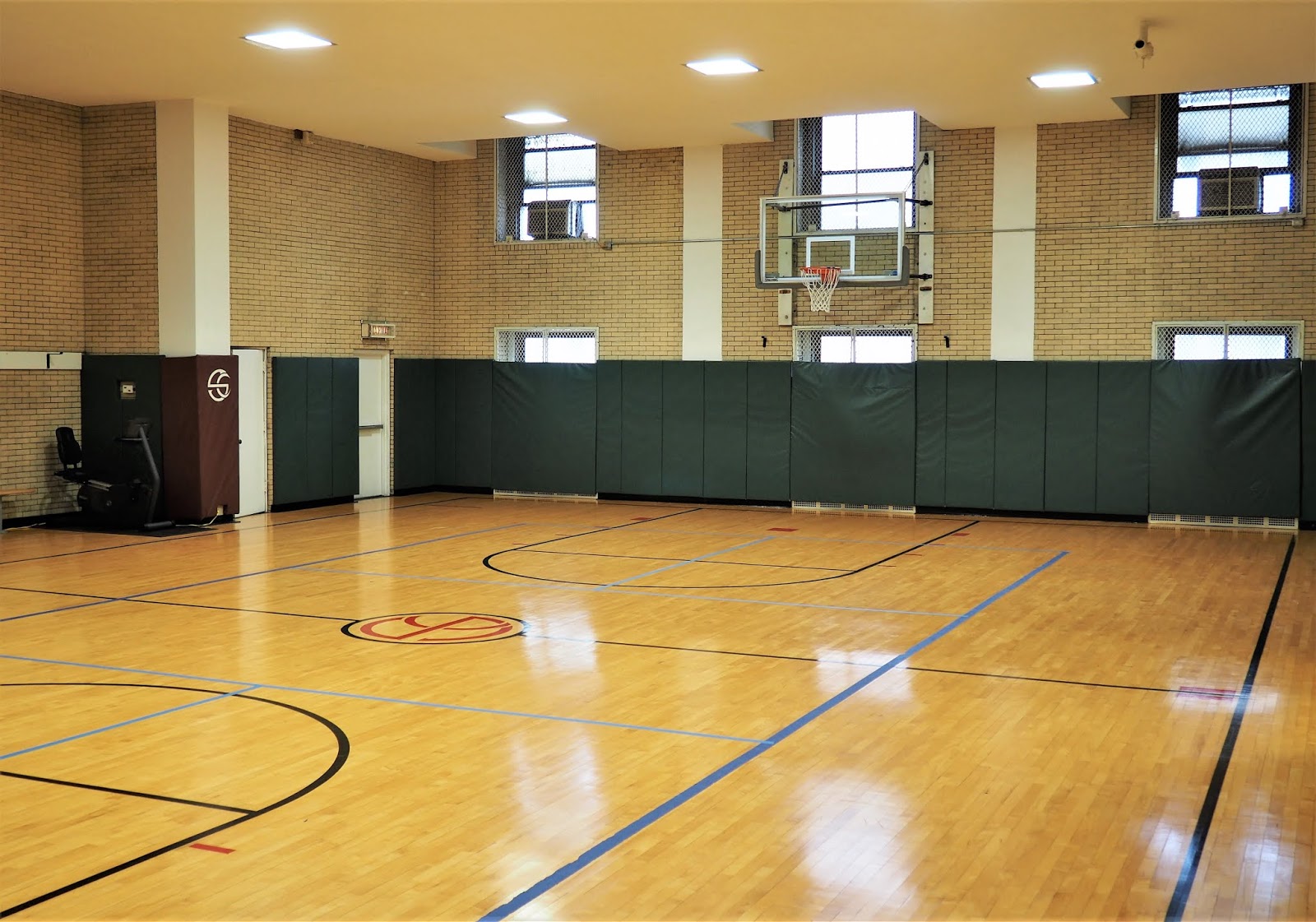
The Standard Club gymnasium. The blue lines are for pickleball

For what one member called “The Last Gentleman’s Game in the Country,” I stepped back on to the 6th-floor court at age 48. Players ranged from 20-somethings to 70 and older. Unwritten rules were simple: no trash-talking, defense calls the fouls and no rough stuff. The last would be broken in league games, tournaments and by occasional hacks or clothes lines. Games were 8 minutes by the clock, and the Health & Fitness Center (H&FC)  supervisors made the teams; rather than winner-stays-on, players were rotated to ensure nobody sat for more than one game at a time. Half-court games resulted if 16 or more members showed up.

One 4-man team wore the color-of-the-day mesh pullovers

Basketball was only played on Monday nights when the games originated in the early 1960s. This produced an interesting story, passed down through the decades. One of the players met the wife of another player, who told him, “I think it’s great you guys play on Monday and Wednesday nights and then go out for dinner.” She eventually found out the truth. They are no longer married.

The drop ceiling limited the length of shots

The basketball players’ annual event – The Hall of Shame Dinner – was held annually for several years, interrupted for five years until one final get-together last year. A Hall of Shame Award winner is chosen, based on a minimum of 10 years’ playing experience; ability (or lack thereof) is not applicable. The dinner featured a speaker from the sports world, preferably basketball. The best during my tenure was the late Norm Van Lier, which included tales of hanging out with Led Zeppelin; last year’s speaker was Matt Gordon, an assistant coach of the Final Four Loyola University Ramblers and brother of H&FC Director Mike Gordon. A side note: When Loyola qualified for the 2018 NCAA tournament, the players anted up to send Mike to Dallas to see the first round. After the Ramblers made it to the second round, we dug deeper into our pockets to send Mike to Atlanta. Against all odds, Loyola made it to the Final Four in San Antonio, and we came through once again for Mike’s plane fare and hotel room.


3-on-3 Tournament, 2002. Only three other members played in the 2020 tournament

The 3-on-3 Tournament, started in 2002, was played for the last time on February 22, 2020. Eight teams are assigned by the H&FC staff for the half-court games. Each game is 12 minutes or if one team scores 10 baskets. My first and only win came in 2012, when we tied a semifinal game on a desperation last-second shot, won on free throws and went on to take the title. The spirited competition features mostly guys in their 20s and 30s. At least two broken noses resulted during the years. After several year’s hiatus, hitting age 70 and sensing this would be the last 3-on-3 tournament, I signed up, hoping not to embarrass myself. Only one other player was older; the two of us were more than 10 years senior to the next youngest players. I held my own; this time we lost in the semifinals on tie-breaker free throws.

3-on-3 Tournament, 2020. John Gable (holding ball) at 73 was the oldest player

I almost forgot to include a tribute to my great friend, Marc Wayne, the other H&FC staffer. The Berwyn native supervised nearly every game, seated at his "office" where he ran the scoreboard (for time, not scores except for league games) and made up the teams. On occasions he would fill in when we were short on personnel, holding back on lofting his soft lefthanded jump shots in deference to the members. His sophomoric humor is loved by all. I'll miss his shouting, "He's no Fred Biletnikoff" every time I muff a pass.

Marc Wayne's "office": the scorer's table

During these 23 years, I’ve had an angioplasty, partial nephrectomy, torn meniscus and extreme lower back pain; each time I stepped back on the court it was like getting a significant part of my life back. The friendships on and off the court transcend a simple game. We did business together, dined together, mourned the loss of thankfully only a few of our stalwarts together, attended Sox games together, watched a son play college basketball together and played basketball outdoors on summer Saturday mornings some 40 miles northwest of Chicago together. The club has entered into an agreement with another downtown club to use its facilities; I've elected not to sign up. Until I find another game, the summer games might be it for my basketball career. If so – and this was My Last Dance – at least I had a final hurrah.

I walked off the court for the last time, April 13, 2020